Bourbon and Books: The Book of Negroes
History Is Messy. This September, Don't Sanitize It — Read It, and Pour Accordingly.
I don't know why September always brings heavy reads. Maybe it's muscle memory from back-to-school, when we'd drag in from summer with a reading list that was never exactly light. *All Quiet on the Western Front*, anyone?
That's the whole spirit of Bourbon and Books, though. Wine gets the book-club table by default. But a considered pour — additive-free, cask strength, chosen with intention — belongs there just as much. Especially with a book that asks this much of you.
The book
This September's pick is *The Book of Negroes* by Lawrence Hill — published in the US, Australia, and New Zealand as *Someone Knows My Name*, softened for readers whose sensitivities run toward the revisionist. Hill took the title from a real historical document: a register kept by British officers at the tail end of the American Revolutionary War, recording roughly 3,000 Black people who had served the King and were fleeing Manhattan for Canada in 1783. Unless your name was in the Book of Negroes, you couldn't board a ship. You couldn't get free.
I'm still reeling that many Black Americans wouldn't pick up the book because of that title — which is exactly why it was changed. And here's my whole feeling about that: history is messy and uncomfortable, and when we try to run from it, when we try to sanitize it, that's precisely when we forget.
The story centers on **Aminata Diallo**, stolen from her home in West Africa and forced into slavery. Hill gives us all of it — the months-long walk to the Atlantic, the horror of the crossing, her enslavement in South Carolina, and her eventual sale and passage to New York, where she finally escapes. Because she can read, write, and speak many languages, she becomes the one entrusted to record the Black individuals who aided the British — the hand behind the register itself. On the surface the outline reads as unrelenting grief. But the real story lives between the lines, in Aminata's resilience — and that resilience is the backbone of this epic. Proof of the beauty, the strength, and yes, the sadness of it is that it was adapted into a miniseries.
For lovers of historical fiction, this is a truly compelling novel. It took me a while to read. Hill doesn't sanitize the reality of the African slave trade, even if the title was later made more palatable. But to learn where you come from, to sit with the trials your ancestors endured, to understand the backbone of your people through a fictional but truthful lens — that's a gift. If you've ever wondered *how did they survive, and later thrive?*, Hill hands you a few of the answers.
The pairing: Say Their Names 🥃
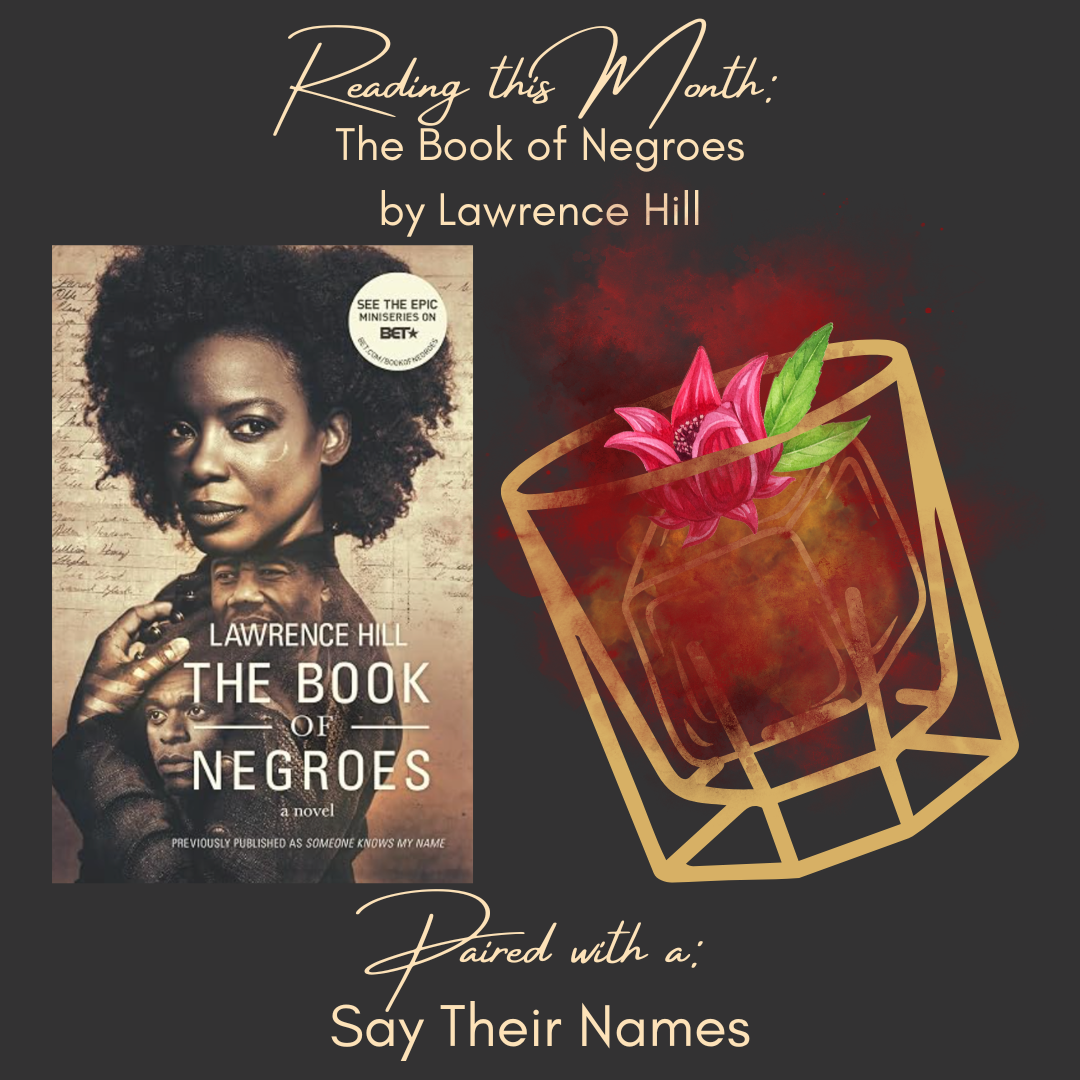
SAY THIER NAMES
Ingredients
2 oz New Dawn 6-Year Cask Strength Bourbon
¾ oz hibiscus (sorrel) syrup
1 teaspoon fresh grated ginger
½ oz fresh lemon juice
1 barspoon dark wildflower honey
2 dashes cardamom bitters
Method: Add all ingredients to a shaker with ice. Shake hard until well chilled, about 12–15 seconds. Strain over one large cube in a rocks glass. Garnish with a wide strip of orange peel expressed over the top and set on the rim like an offering, plus one dried hibiscus flower.
Hibiscus (sorrel) syrup:Bring to boil 1 cup of water, ¼ cup dried hibiscus, 2 slices fresh ginger, 4 cloves, 6 cardamom pods, 1 cinnamon stick, 1 anise pod, and a strip of orange peel. Reduce temp and simmer for 15 minutes. Strain; stir in ¾ cup sugar while warm. Cool. Keeps refrigerated up to 2 weeks.
Drink responsibly. 21+.
September is Bourbon Heritage Month — and I don't toast the month without naming whose month it is. Bourbon was shaped by enslaved and freed Black distillers: the hands that tended the mash and read the char on the barrel while someone else signed the label. That silence is the same one Aminata spends a whole novel refusing. A register of names as the only door to freedom; a woman who survives, in part, because she can write the names down. Remembering, here, isn't sentiment. It's survival.
A hibiscus cask strength bourbon sour — ancestral, tart, and warm.
So the cocktail carries a name and an ingredient home. Hibiscus — known across the West African and Caribbean diaspora as *sorrel* or *bissap* — made the same crossing so many of our ancestors did, and became a drink of home on the other side of the water. Bourbon grown from New York grain and ginger for a bit of bite and to remind history isn’t always gentle. Tart, warm, and poured with intention — best made for someone whose name you want to say out loud.
The whiskey
Our 6-Year Cask Strength Bourbon (70% corn, 15% rye, 15% barley, from organic New York grain, aged at Alton Distillery in the Catskills) is the bold, fruit-forward one in the cabinet — a rich nose of cherry, vanilla, and croissants, with surprising depth for something bottled at full strength. Nothing is watered down; nothing is added; there's nowhere to hide. In Say Their Names, the tart hibiscus and bright lemon cut clean through the cask-strength richness while the honey and ginger lean into that cherry-vanilla core — bold enough to hold its own at full proof, the mountain's climate still legible in every sip.
Why this one belongs on your table
The Book of Negroes is about lineage you don't get to choose, and the names that had to be written down so people could survive. New Dawn is about the same things from the other side — a Black woman-owned whiskey reclaiming space in an industry our people helped build, small-batch and additive-free, personally chosen by Dr. Dawn O'Neal from a palate honed across generations. This month, drink like it means something. Bold by nature, built with care. Sip with purpose.
**Join our email list before the next chapter, pour the 6-Year for someone at your table, and say the name of one person who taught you to taste.**