Where the City Meets the Spirit: The Corner Bar Connection
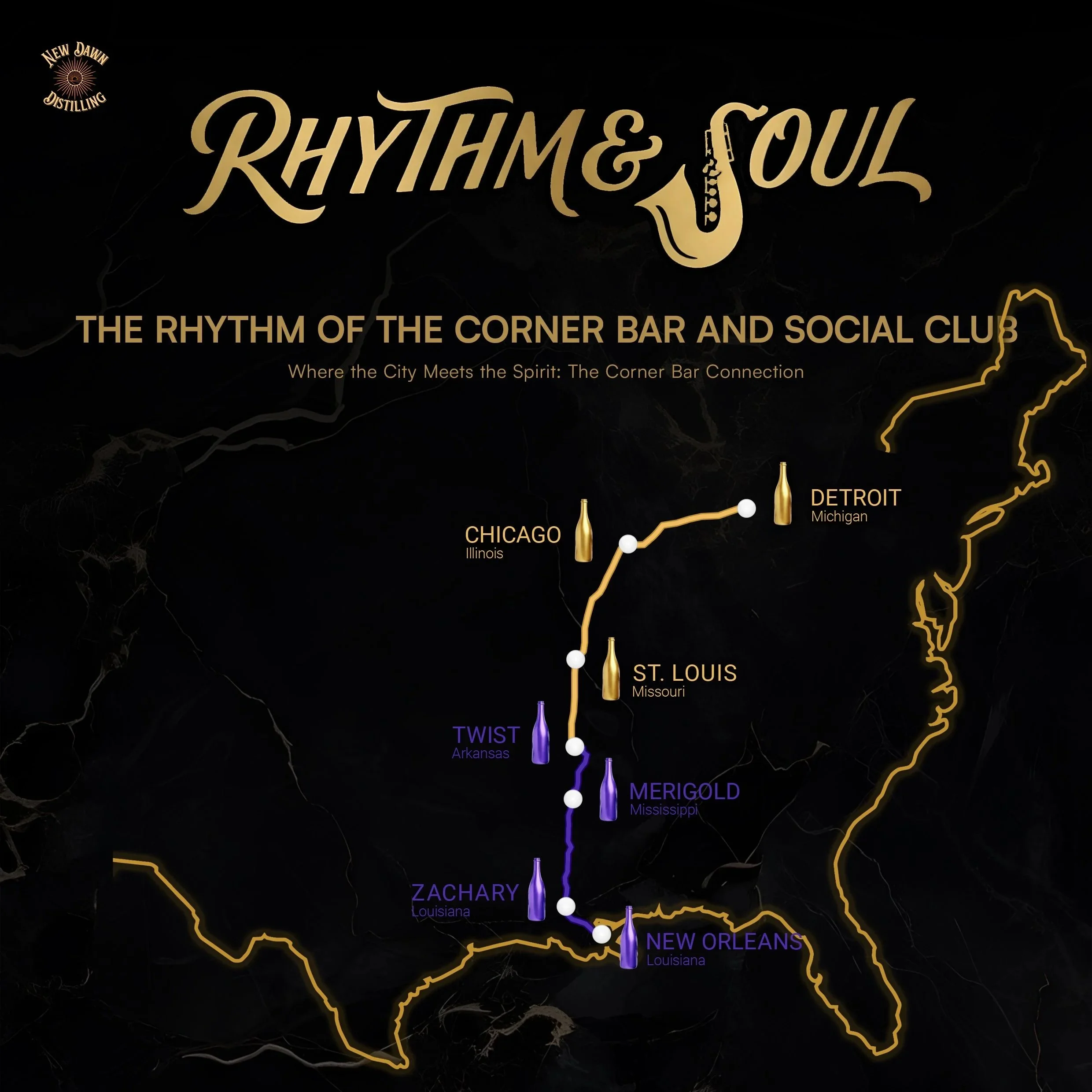
In Black history, the corner bar and local social club were more than just places to drink—they were vital cultural hubs, incubators for jazz, blues, and community action. From Chicago, Illinois to Harlem in New York, these spaces provided refuge, connection, and a stage for the soulful rhythm that connects these two great cities.
New Dawn Distilling embodies this geographical soul. Distilled in the precise environment of New York, our spirit is imbued with the sophistication of the city, yet it is ultimately selected and refined by me, whose New Orleans spirit guides its perfect balance.
This week, we honor the legacy of the corner bar—the place where the community's pulse beat strongest.
Cultural Significance of the Corner Bar
For the Black community, particularly during the era of segregation, the corner bar and social club served as crucial counter-institutions. Denied access to many public spaces, these establishments became much more than taverns; they were safe havens, informal meeting halls for civil rights organizers, financial networks (often operating as informal banks), and, most famously, the essential proving ground for American music. They fostered community resilience, provided employment, and cemented the cultural identity that defines Black urban life, connecting disparate neighborhoods across the country.
These establishments were sanctuaries of self-determination. They provided a stage for Black artists who were often barred from mainstream venues, birthing genres like Bebop. Beyond the music, they were the birthplace of political movements and provided crucial, informal spaces for Black professionals and laborers to network, offering a sense of belonging and agency in a discriminatory world.
Historic Examples: Anchors of Culture
Rosebud Bar and Cafe (St. Louis, MO)
From its origin at the turn of the 20th century, Mill Creek Valley was a vibrant center for Black life in St. Louis, sometimes likened to New York's legendary Harlem. With a population of nearly 20,000 people and over 5,000 buildings, Mill Creek was a "city within a city," known for its rich culture, popular entertainment venues, major Black newspapers, and as a hub for Black professionals and social activism. All of this flourished despite the stark racial segregation of the era, providing African Americans a refuge. Sadly, almost no trace of Mill Creek remains today, as it was destroyed in 1959 under the banner of urban renewal.
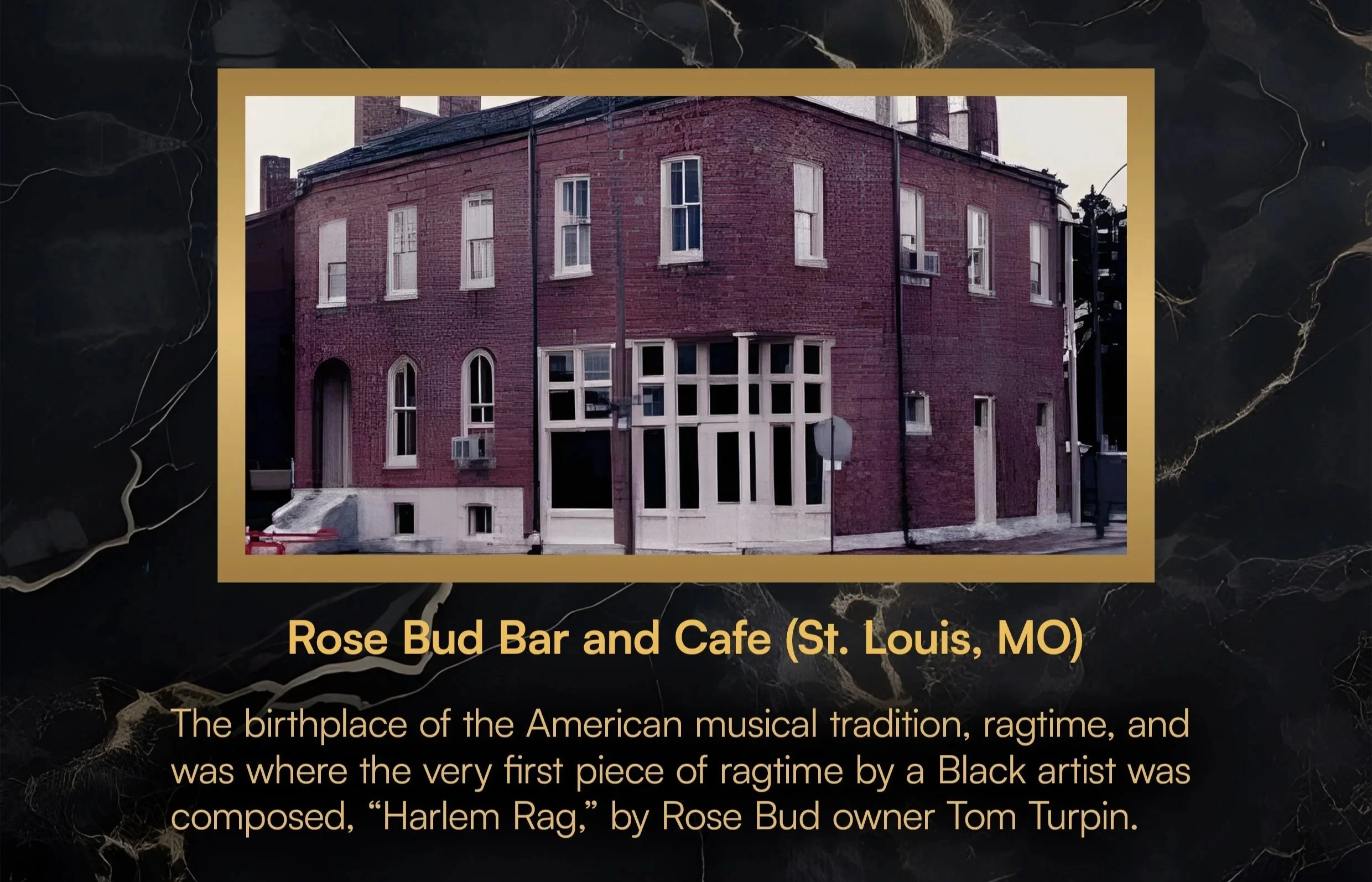
One of its most famous locations was the Historic Rosebud Cafe, the birthplace of the American musical tradition, ragtime. Located at the corner of Market and Clark, the saloon was owned by Tom Turpin, who earned the title "Father of St. Louis Ragtime." Turpin, who moved to St. Louis in the early 1880s, opened the Rosebud Cafe, which became a popular hub for ragtime musicians and fans from around the country, including figures like Scott Joplin and Joe Jordan. Turpin was also a composer, and with the "Harlem Rag," he became the first African American to publish a ragtime song. The establishment has been historically recognized as one that "nurtured and showcased" the remarkable skill of Black ragtime composers. The Rosebud Cafe eventually closed in 1906, but its legacy lives on in songs like Scott Joplin's "The Rosebud March."
The Palm Tavern, Bronzeville, Chicago
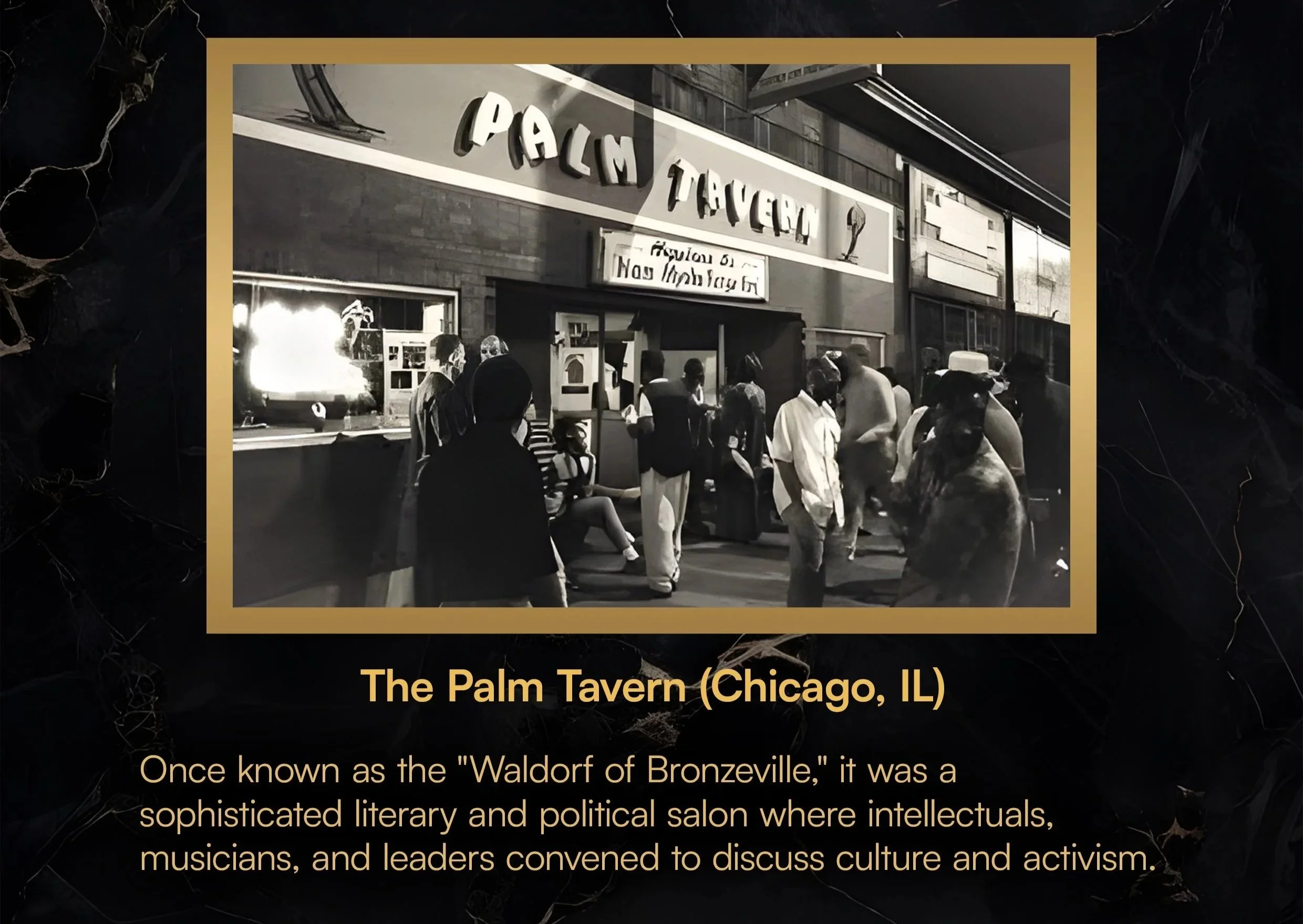
The Palm Tavern, on the southside of Chicago in then Bronzeville district, operated from 1931 (or 1933) to 2006. Bronzeville was a lively Black community during the Great Migration, filled with theaters (Regal, Metropolitan, Savoy Ballroom) and numerous Black-owned businesses, restaurants, and clubs. Despite urban renewal, highways, public housing, and disinvestment devastating the area, the Palm Tavern resiliently endured as a vital historical landmark.
Established by James "Genial" Jim Knight, the tavern quickly became a vital cultural hub during the Black Chicago Renaissance. It was a "must do" stop for jazz legends like Dizzy Gillespie, Count Basie, Duke Ellington, and Josephine Baker, who often performed nearby at the Regal Theater. Writers such as Richard Wright and Langston Hughes also frequented the spot.
Gerri Oliver purchased the Palm Tavern in the 1950s and ran it for nearly 50 years, transforming it into "Gerri's Palm Tavern." She was renowned for her hospitality and her famous red beans and rice, a dish performers would request upon arrival. Oliver's venue evolved into a critical, authenticity-driven catch-all for the city's Black history, remaining resilient even as surrounding landmarks in Bronzeville were lost to urban renewal and disinvestment. In 1983, it hosted a grassroots fundraiser that helped elect Harold Washington, Chicago's first Black Mayor.
The Palm Tavern's legacy is rooted in an era of segregation, yet it grew in importance as a connecting thread to Bronzeville's past. Oliver stewarded the venue until its closure in 2001, warning that its destruction would sever a vital link to history. Despite its cultural significance, the legendary establishment was ultimately demolished and is now an empty lot.
Café de Champion (Chicago, IL)
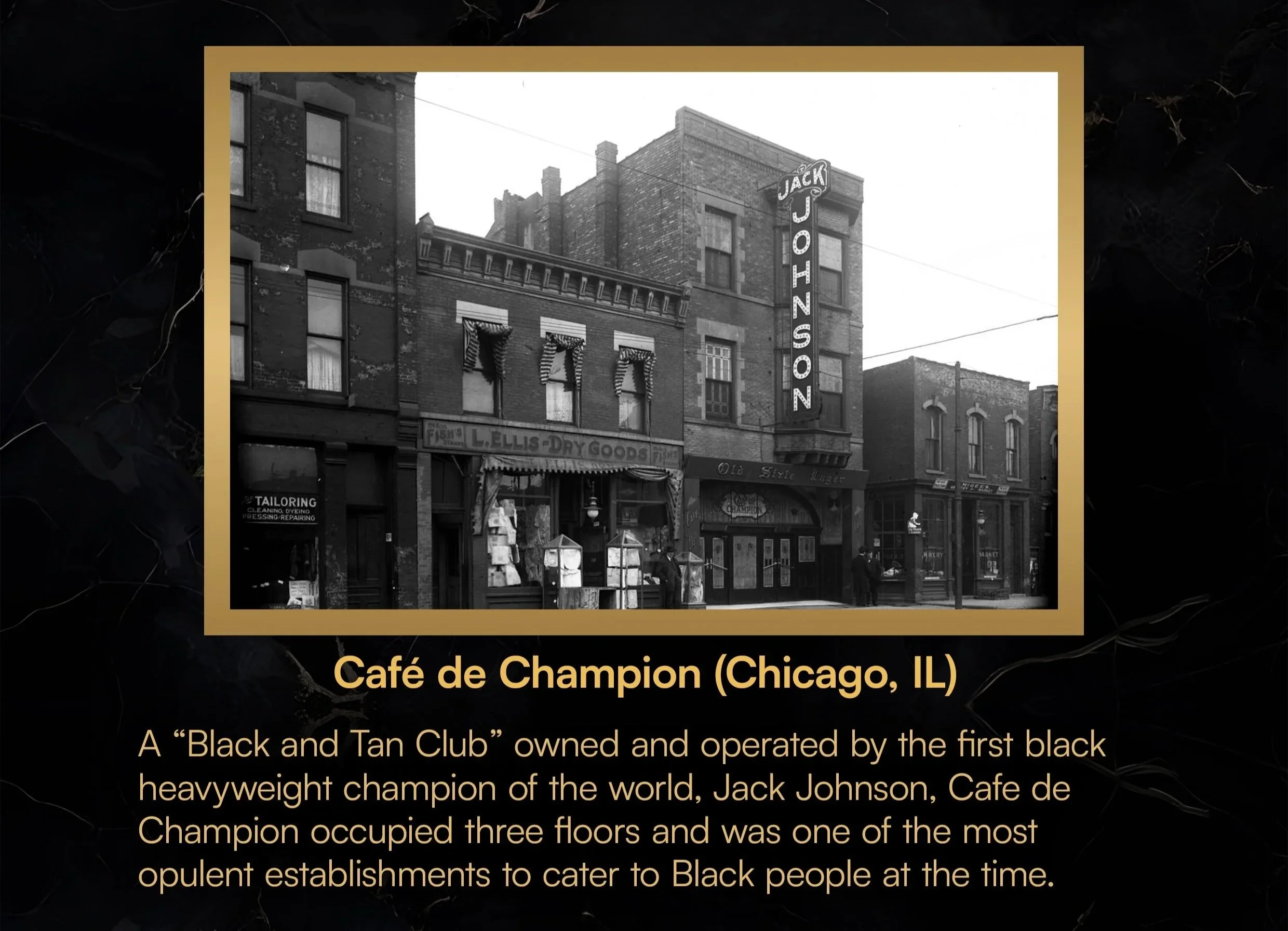
Born in Galveston, Texas, in 1878, Jack Johnson made history in 1908 by becoming the first African American World Heavyweight Boxing Champion, a title he held until 1915. His career was marked not only by athletic brilliance but by his flamboyant defiance of the rigid racial conventions of the era
Johnson became an entrepreneur and nightlife impresario in 1912 with the opening of Café de Champion in Chicago, which stood as a powerful symbol of Black excellence and self-determination. The establishment was known as a "Black and Tan Club," meaning it welcomed patrons of all races, a radical concept in segregated Chicago. Located in the heart of the city, the Café de Champion was opulent for its time, spanning three floors and offering sophisticated dining, dancing, and high-quality entertainment. It catered primarily to a Black clientele but served as a defiant testament to Johnson's belief in equality and was a glittering alternative to the discriminatory venues of the time, further solidifying the corner bar's role as an anchor of cultural and social freedom.
Johnson's achievements made him a hero to many Black Americans, a defiant figure who stood up to a racially hostile world. However, his life was also fraught with controversy. He faced allegations of spousal abuse, particularly in his later relationships. In 1912, he was convicted under the Mann Act (transporting women across state lines for "immoral purposes") after marrying Lucille Cameron, a white woman. A warrant was issued for his arrest while he was in Europe, effectively forcing him into exile for several years and tarnishing his public image with legal troubles that many felt were racially motivated.
Blue Bird Inn (Detroit, MI)
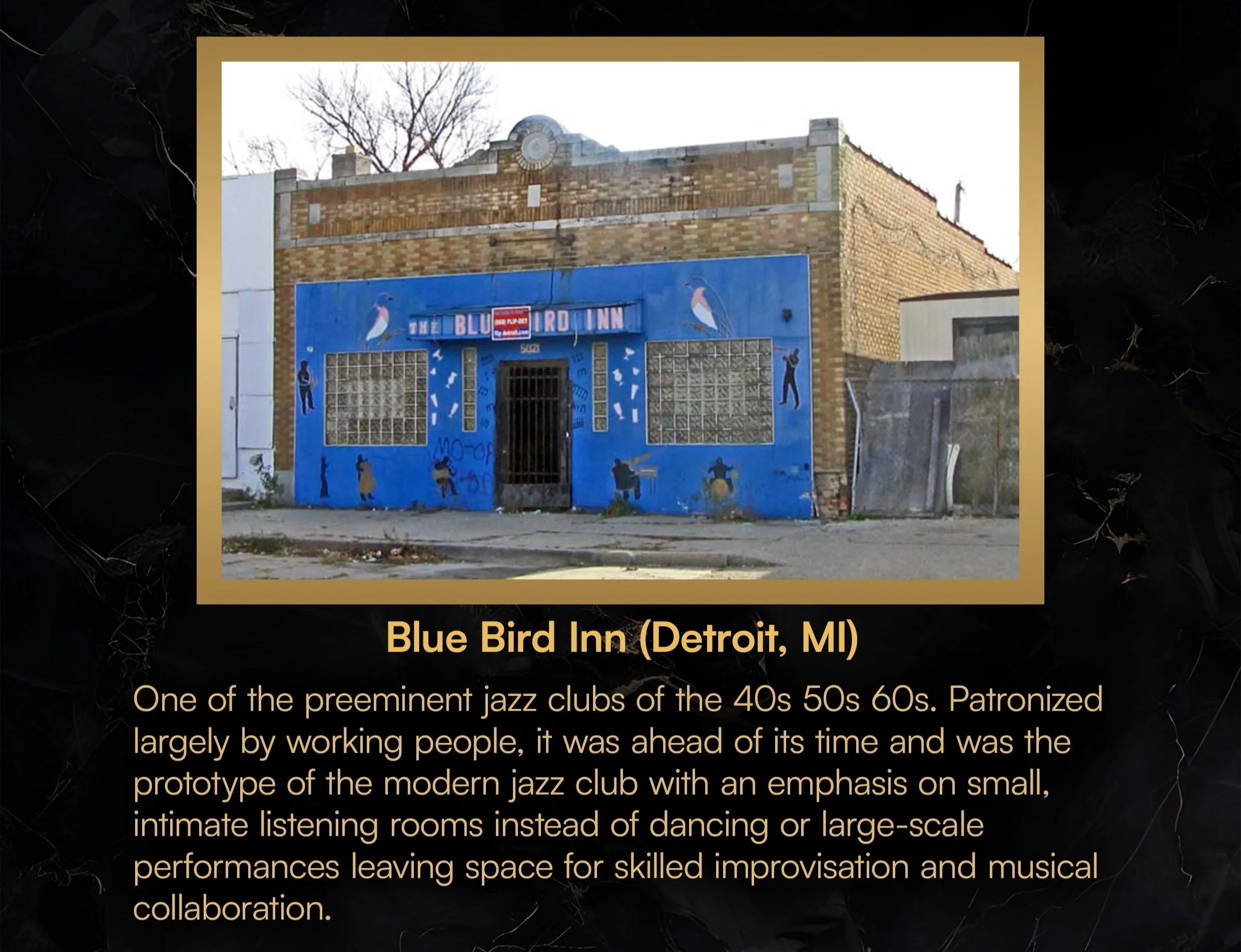
The Blue Bird Inn, a Detroit neighborhood bar at 5021 Tireman, opened in 1937 by William DuBois. In 1948, his son Buddy modernized the club and introduced a live music policy, hiring Phil Hill to form a house band specializing in bebop, starting September 9, 1948. The Inn's casual setting quickly made it a musician's favorite, distinguishing it from formal clubs and establishing it as a prototype of the intimate modern jazz club with an emphasis on small, intimate listening rooms instead of dancing or large-scale performances leaving space for skilled improvisation and musical collaboration. Charlie Parker joined an unpublicized jam session on October 1, 1949.
For the next decade, the Blue Bird Inn was crucial for developing modern jazz talent, often called a "finishing school." A major 1957 remodel transformed it into a premier jazz club, moving the stage and focusing on five to six-day engagements for national acts, including returning former house band members like trumpeter Thad and drummer Elvin Jones, Donald Byrd, Tommy Flanagan, Barry Harris, and Yusef Lateef. Though live music continued in the 1960s, its time as the bebop epicenter faded as other clubs emerged.
The Blue Bird Inn is nationally significant for its contributions to bebop and its association with jazz legends like Parker, Miles Davis, John Coltrane, and Tommy Flanagan, and locally significant for representing Detroit's racial and demographic shifts.
A Taste of Two Cities: Pairing Suggestion
To fully appreciate the spirit of resilience and community these venues represent, we suggest enjoying New Dawn alongside a southern meal. The complexity and smoothness of our spirit complement the rich, soulful flavors of classic dishes—a nod to the deep culinary roots that sustained and celebrated Black culture in these urban centers. Pair it with a plate of slow-cooked collard greens, smoked brisket, or a classic shrimp and grits to bring the Rhythm & Soul right to your table.
Frequently Asked Questions (FAQ)
Q: Why is the "corner bar" significant in Black history?
A: The corner bar and social club served as crucial counter-institutions, safe havens, informal meeting halls for civil rights organizers, financial networks, and, most famously, essential proving grounds for American music like jazz and blues, particularly during the era of segregation. They were sanctuaries of self-determination.
Q: How does this legacy connect to New Dawn Distilling today?
A: New Dawn Distilling embodies this geographical soul. While distilled in New York, the spirit is refined and balanced by the brand's founder, whose New Orleans spirit guides the final product, mirroring the cultural connection between the North and South, or the "two cities."
Q: What is the "Chitlin' Circuit"?
A: The "Chitlin' Circuit" was a network of performance halls, theaters, and nightclubs across the United States that were safe and acceptable places for Black musicians and entertainers to perform during the era of racial segregation. Many corner bars were key parts of this circuit.
Q: What was the Rose Bud Bar and Cafe known for?
A: The Historic Rosebud Cafe, owned by Tom Turpin, is known as the birthplace of American ragtime music and nurtured the skill of composers like Scott Joplin.
Q: What is the legacy of The Palm Tavern in Chicago?
A: The Palm Tavern was a vital cultural hub during the Black Chicago Renaissance, a "must do" stop for jazz legends and writers, and later became a resilient landmark under Gerri Oliver, even hosting a fundraiser for Mayor Harold Washington.
Q: What was unique about Jack Johnson's Café de Champion?
A: Founded by the first African American World Heavyweight Boxing Champion, Jack Johnson, the Café de Champion was a "Black and Tan Club," meaning it welcomed patrons of all races, a radical act of defiance against segregation at the time.
Q: Why is the Blue Bird Inn in Detroit nationally significant?
A: The Blue Bird Inn was crucial for developing modern jazz talent, often called a "finishing school," and is associated with bebop legends like Charlie Parker, Miles Davis, and John Coltrane.
Q: What is a suggested pairing for New Dawn Distilling spirit?
A: The post suggests enjoying New Dawn alongside a southern meal to complement the spirit's complexity and smoothness with rich, soulful flavors, such as slow-cooked collard greens, smoked brisket, or classic shrimp and grits.