Bourbon and Books: The Broken Earth Trilogy
As Earth Month rolls around, a lot of us are thinking about recycling, planting trees, and maybe signing a petition or two. But what about picking up a fantasy novel?
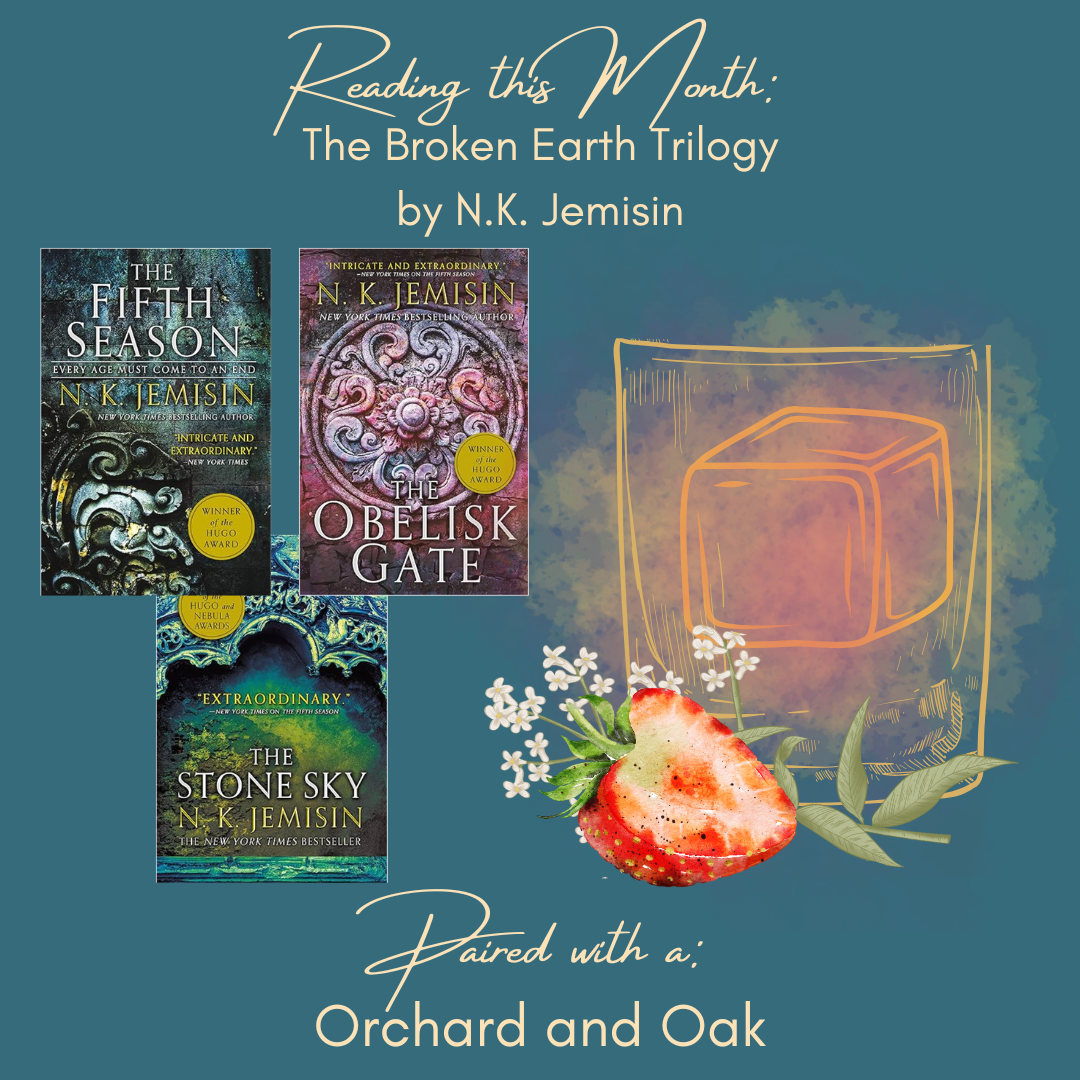
N.K. Jemisin's The Broken Earth Trilogy—comprising The Fifth Season (2015), The Obelisk Gate (2016), and The Stone Sky (2017)—is a three time Hugo Award winning work of speculative fiction that is more than just a sci-fi epic—it’s a terrifyingly relevant portal into our own possible future. Set on a planet, the Stillness, that is constantly being ripped apart by geological catastrophes ("Fifth Seasons"), the series forces us to confront what happens when environmental crisis becomes the norm.
Reading for the Planet
The central critique isn't just about environmental change, but about social injustice being the root of environmental collapse. Jemisin shows how the destruction of the earth began with the brutal exploitation of its people—the Orogenes who have the ability to manipulate seismic energy. Feared, enslaved, and forced to stabilize society, the treatment of the Orogenes mirrors real-world patterns where we dehumanize those we fear. They are viewed as tools, not people, highlighting how powerful institutions profit from the forced labor of marginalized groups inevitably leading to the dehumanization of the planet itself.
The trilogy's arc—following the protagonist Essun and her daughter Nassun—deepens this connection:
The Fifth Season establishes the setting and the foundational injustice: the system designed to manage the crisis (the Fulcrum) becomes a tool to violently control and exploit marginalized groups.
The Obelisk Gate explores adaptation and resilience, contrasting the surface-dwellers who cling desperately to old, oppressive structures with communities like Castrima, which offer a fragile, hopeful model for a society built on mutual respect rather than exploitation.
The Stone Sky brings the trilogy to a cataclysmic conclusion, revealing that the Fifth Seasons were not always natural. The devastation is shown to be the result of an ancient, colossal act of technological hubris and planetary sabotage driven by short-sighted human ambition. I won’t spoil it, but know that just like today social injustice is intrinsically linked to environmental collapse.
Jemisin’s trilogy, much like Octavia Butler's Parable of the Sower, asks us to realize that true environmental resilience requires nothing less than radical social change and the liberation of the marginalized. The ultimate environmental goal is not just surviving the seasons but ending the underlying systems that enable them, equating environmental justice with fundamental societal change.
When Fantasy Mirrors Reality
Using fantasy to break down how oppression works, Jemisin shows us that if we keep letting short-sighted ambition and systemic hatred run our societies, we risk a future where:
Catastrophe is normalized: Just like the Stillness, our world could be constantly on the brink, forcing us into a state of perpetual scarcity and panic.
Oppression is rationalized: The systems designed to manage the crisis (like the Fulcrum) become tools to violently control and exploit marginalized groups.
We break the planet:The Stone Sky reveals the biggest twist—the environmental devastation wasn't natural, but the result of an ancient, colossal act of technological hubris. It's a stark warning about the irreversible damage caused by trying to master nature instead of living in harmony with it.
The trilogy is a stunning achievement in world-building and a profound, necessary meditation on resilience, trauma, and the fight for fundamental human dignity. Saving the planet isn't just about the climate; it's about defining our humanity.
The Pairing
Pairing this trilogy with an Orchard & Oak. A complex libation with the warmth and stability of New Dawn bourbon’s brightened by the hopefulness of strawberry and verbena with just a touch of aromatic vermouth for complexity. It’s a grounding cocktail that even goes so far as to evoke the series' major themes of earth-shattering upheaval, subterranean power, and the resilience of life.
FAQ
Q: What is The Broken Earth Trilogy?
A: A Hugo Award-winning speculative fiction series by N.K. Jemisin, comprising The Fifth Season, The Obelisk Gate, and The Stone Sky. It is set on the geologically volatile planet called the Stillness.
Q: What is the main theme of The Broken Earth Trilogy?
A: The core theme is the intrinsic link between environmental collapse (Fifth Seasons) and systemic social injustice, specifically the enslavement of people with seismic powers (Orogenes).
Q: Who are the Orogenes in N.K. Jemisin's trilogy?
A: Orogenes are individuals who can manipulate seismic energy to stabilize the ground. They are simultaneously feared, enslaved, and forced to stabilize society by the ruling power structure (the Fulcrum).
Q: What is a "Fifth Season" in the books?
A: A Fifth Season is a period of severe, planet-wide geological catastrophe (e.g., volcanic eruptions, climate shifts) that forces societies into a state of panic and scarcity.
Q: Who is the protagonist of The Broken Earth Trilogy?
A: The primary protagonist is Essun, a powerful Orogene mother whose journey begins after a catastrophic Fifth Season and the disappearance of her family.
Q: Is The Broken Earth Trilogy only about climate change?
A: No. While it uses environmental crisis as a backdrop, the series argues that the devastation was caused by ancient technological hubris and systemic hatred. True resilience requires radical social change and liberation of marginalized groups.
Q: Why is The Broken Earth Trilogy relevant during Earth Month?
A: It serves as a warning that societal ambition and systemic hatred risk normalizing catastrophe, rationalizing oppression as a crisis response, and causing irreversible environmental damage through efforts to master nature instead of living in harmony with it.
Q: What cocktail is recommended as a pairing for reading the trilogy?
A: The recommended pairing is an "Orchard & Oak" cocktail, made with New Dawn bourbon, strawberry, verbena, and aromatic vermouth.